Indian Wedding Functions in Order
The usual order of Indian wedding functions, day by day, with honest regional differences from Punjab to Tamil Nadu and Bengal to Kerala.
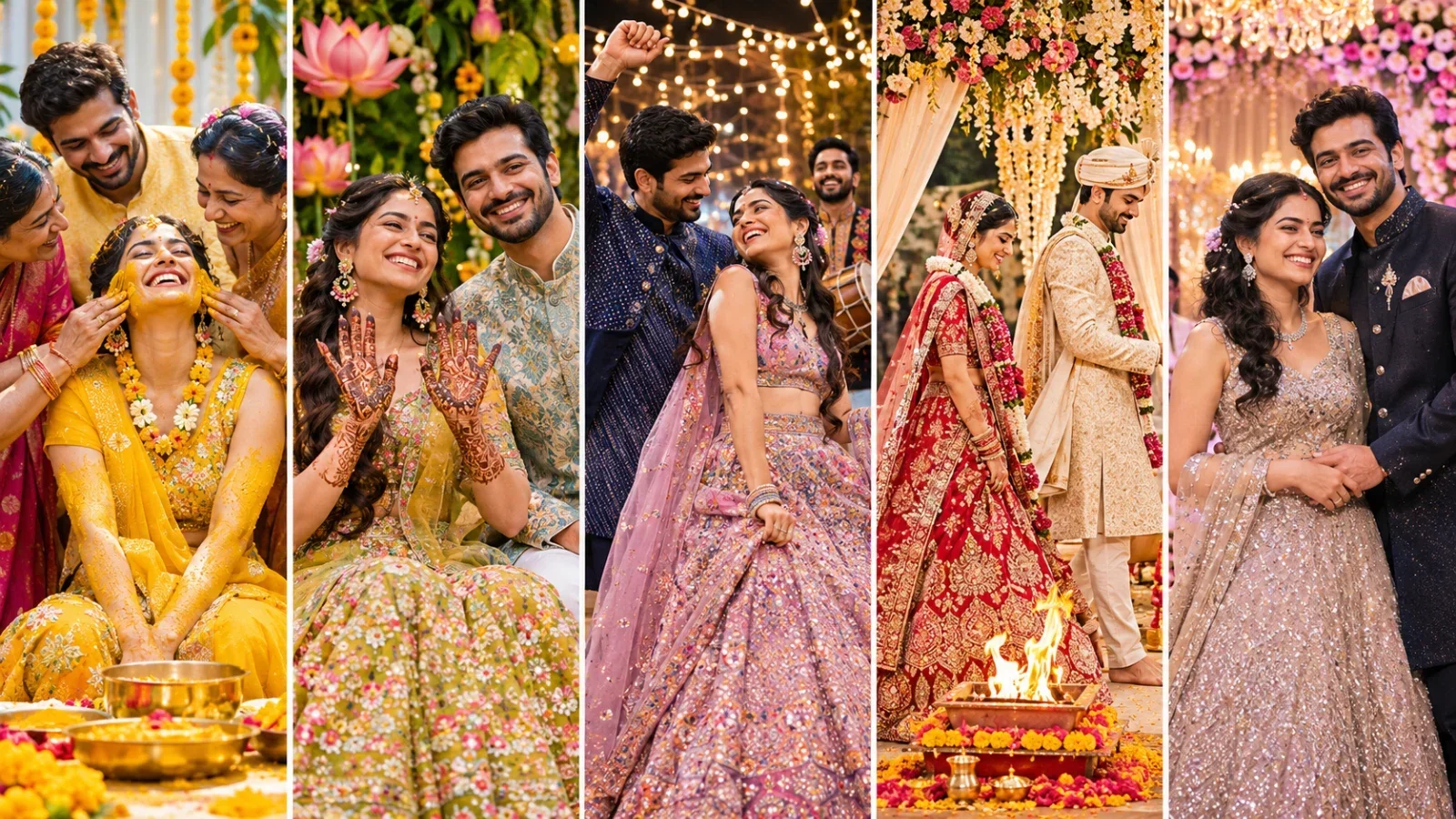
What is the order of Indian wedding functions?
The usual order of Indian wedding functions is roka or engagement, mehndi, sangeet, haldi, the wedding ceremony, vidaai and the reception. The pre-wedding functions usually fall in the two or three days before the wedding. The order changes by region and community, so Tamil, Bengali, Sikh and Muslim weddings each have their own sequence.
roka or engagement
mehndi, sangeet, haldi
baraat, varmala, kanyadaan, pheras
vidaai, then the reception
An Indian wedding is rarely one event. It's a run of functions over several days, each with its own guest list, dress code and mood: a quiet blessing one morning, a dance-off the next night, a sacred fire at dawn.
The order below is the one most guides describe, based on North Indian Hindu weddings. It is not universal. Further down you'll see how Tamil, Telugu, Bengali, Gujarati, Marathi, Sikh, Muslim and Christian weddings differ.
What is the usual order of Indian wedding functions?
- Roka or sagai. The families formalise the match, often weeks or months ahead. Rings may be exchanged at the engagement.
- Mehndi. Henna is applied to the bride's hands and feet, usually a day or two before the wedding.
- Sangeet. A night of music, dance and family performances.
- Haldi. Turmeric paste is applied to the couple, often on the wedding morning or a day or two before (Tatler Asia, 2024).
- The wedding. The ceremony itself, usually at an auspicious time, the muhurat.
- Vidaai. The bride's farewell to her family.
- Reception. A party to introduce the couple, often hosted by the groom's family.
Which comes first, mehndi or sangeet? It depends on the family. Many hold them on separate evenings, and many now merge them into one night.
What happens on the wedding day?
In many North Indian weddings the day runs like this:
- Baraat: the groom arrives with music and dancing, sometimes on a horse.
- Milni: in Punjabi families, elders of both sides greet and embrace.
- Varmala: the couple exchange garlands.
- Kanyadaan: the bride's parents give her hand in marriage. Some families now adapt this rite.
- Pheras: the couple circle the sacred fire, often seven times, making vows.
- Sindoor and mangalsutra: the groom applies vermilion to the bride's parting and ties the mangalsutra.
The muhurat can fall at dawn, midday or after midnight, so the ceremony time on the card matters more than the party times.
How do South Indian weddings differ?
- Tamil weddings often begin with nichayathartham, the formal engagement. In many Tamil Brahmin weddings, the groom sets off on a mock pilgrimage on the day, the Kasi Yatra, before the bride's father persuades him to marry. The thali is tied at the muhurtham, and in many Tamil families the reception is held the evening before.
- Telugu weddings have pellikuthuru and pellikoduku, when the bride and groom are bathed and dressed for the wedding. At the muhurtham the couple place jeelakarra bellam on each other's heads, then shower each other with talambralu, turmeric-coloured rice.
- Kerala Hindu weddings are often short, sometimes under an hour, centred on tying the thali.
How do East and West Indian weddings differ?
- Bengali Hindu: aashirbaad (blessings), gaye holud (turmeric), then the wedding, usually in the evening, with saat paak, shubho drishti and sindoor daan. Bou bhaat, at the groom's home, comes after.
- Gujarati: pithi (turmeric), and a garba or raas night that often replaces the sangeet.
- Marathi: halad (turmeric), and the antarpat, a cloth held between the couple until the mangalashtak verses end.
What about Sikh, Muslim and Christian weddings in India?
- Many Sikh weddings in Punjab and the diaspora run roka, kurmai (engagement), chunni chadana, maiyan (turmeric) and a late-night jaggo, then the Anand Karaj at the gurdwara, usually in the morning, and the doli (farewell).
- Many South Asian Muslim weddings run mangni, manjha or mayun (turmeric), mehndi, the nikah ceremony, rukhsati and the walima feast.
- Syrian Christian weddings in Kerala often include the madhuram vaippu, a sweet-sharing ritual, and a church wedding where the groom ties the minnu. Goan and Mangalorean Catholic families hold the roce, a coconut-milk anointing, before the wedding.
How do diaspora weddings change the order?
In the US, UK, Canada and the UAE, many couples fit the functions into a long weekend: mehndi and sangeet on Friday, the ceremony on Saturday morning, the reception that night. Venue hire and guests' travel shape the schedule more than tradition does.
For how these sit beside Christian, Jewish, Chinese and Yoruba ceremonies, see our guide to wedding ceremony rituals around the world.
Planning several functions?
Each function usually has its own guest list. On Evatril, one invitation can carry every function as a sub-event, and each guest replies only to the ones they're invited to. See the occasions Evatril is built for, and our guide to setting up Multi-RSVP for Indian weddings shows how Evatril gives you a separate count for each function.
Whose customs can a Hindu wedding follow?
Under India's Hindu Marriage Act, 1955, a Hindu marriage may be performed using the customary rites of either the bride's or the groom's side (Section 7(1)).
When does a Hindu marriage become binding?
Where the rites include saptapadi, the seven steps the couple take together before the sacred fire, the law says the marriage becomes complete and binding when the seventh step is taken (Section 7(2)).
What is haldi paste made of?
Tatler Asia (2024) describes the haldi paste as turmeric, sandalwood powder, rosewater and other natural ingredients, and notes it doubles as a traditional facial for the couple.